Story
Only the Shadow
"Nothing in here falls by chance"
Manchester. Saturday, 11 June 1949.
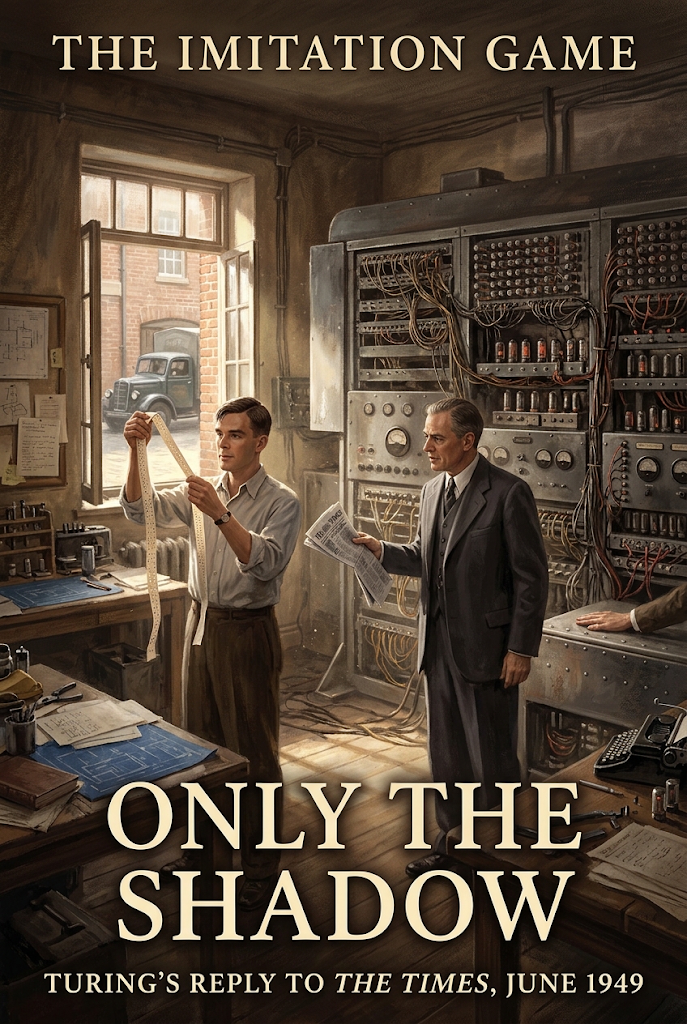
The machine filled most of the room and gave off the heat of a small foundry. That was why the window stood open in June, and why Alan Turing, who had run to work as he did most mornings, was still in his shirtsleeves, reading a strip of punched tape against the light.
Max Newman came in holding The Times the way a man holds a summons.
“Page four.”
“Good morning, Max.”
“Is it? Page four. Read it.”
Turing didn’t look up from the tape. “I know what it says. I said it.”
“You said it to a reporter.”
“He telephoned. It seemed rude to hang up.”
“It would have been rude, Alan. It would also have been policy.”
Newman found the paragraph with his thumb and read it aloud in the voice he kept for examination results.
“‘I do not think you can even draw the line about sonnets, though the comparison is perhaps a little bit unfair, because a sonnet written by a machine will be better appreciated by another machine.’”
“That’s accurate.”
“I didn’t ask whether it was accurate.”
“Then what did you ask?”
“Whether you’ve met Geoffrey Jefferson.”
“Twice. He’s a neurosurgeon. He has very clean hands.”
“He’s a neurosurgeon who stood up at the Royal College of Surgeons on Thursday and gave the Lister Oration. He told them no machine will equal a brain until it can write a sonnet ‘because of thoughts and emotions felt, and not by the chance fall of symbols.’ And on Saturday morning my deputy answers him in The Times.”
Turing set the tape down.
“‘The chance fall of symbols.’ That’s the part I minded.”
“Of the whole oration, that’s the part you minded.”
“Nothing in here falls by chance, Max. That’s rather the point of it.”
Newman put the paper on the bench, face up, where neither of them could pretend it wasn’t there.
“The Vice-Chancellor rang me at eight.”
“On a Saturday?”
“He wanted to know whether the university has built a brain.”
“What did you tell him?”
“That I’d ask.” Newman waited. “Have we?”
“We’ve built a machine that can do anything a brain can do, provided the brain is willing to write down how.”
“That isn’t a yes.”
“It’s a better answer than yes. Thirteen years ago I proved that one machine could do the work of every other machine, given the right instructions.”
“I remember. I’m the one who sent it to the London Mathematical Society.”
“You are. You can’t now be surprised by where it went.”
“I’m not surprised. I’m being telephoned. It’s different.”
Turing went to the window. Outside, a lorry was trying to reverse into a street that had been built for horses.
“What does Jefferson want?”
“A seminar. Polanyi’s arranging it for the autumn. Jefferson, you, me, a philosopher or two, and anyone else in the faculty who can be trusted with a teacup.”
“And he’ll ask whether it really thinks.”
“He’ll ask nothing else.”
“Then he’ll be asking the wrong question. I believe the original question, ‘Can machines think?’, to be too meaningless to deserve discussion.”
“You can’t say that at a seminar.”
“Why not?”
“Because there’ll be philosophers at it, Alan. Discussing meaningless questions is how they’re paid.”
Turing almost smiled, which for him meant he looked briefly at the floor.
“Do you know the party game?”
“Which party game?”
“The one with the man and the woman.”
“I don’t go to parties.”
“Nor do I. I’ve read about them. You put a man and a woman in another room. The judge stays out here and sends in written questions, and the answers come back typed, so the handwriting can’t give anything away. The judge has to say which one is the woman.”
“And the woman tells the truth.”
“She tries to help the judge. The man’s job is to make the judge guess wrong.”
“I’ve always found that game faintly unpleasant.”
“Everyone in it is lying except the judge, and the judge is the only one who’s confused. I find that very restful.” Turing turned from the window. “Now take out the man.”
“And put in what?”
Turing laid a hand flat on the casing of the machine, the way you’d reassure a horse.
Newman looked at the hand, then at the machine, then back at Turing.
“If the judge guesses wrong as often with that as he does with the man...”
“...then the question stops mattering. That’s a different thing from answering it, and far more useful.”
“Jefferson will say it’s only imitating.”
“So is the man, Max. He’s imitating a woman, and nobody at the party asks whether he really feels like one.”
Newman picked up the paper, folded it in half, then in half again, until page four was hidden inside it.
“Write it down. Properly. Not for The Times. For Mind, or somewhere people can’t quote you in a headline.”
“They’ll quote me anyway.”
“Then make it worth quoting. And give it a better name than ‘the party game.’”
“I’ll call it what it is. An imitation game.”
Newman went to the door and stopped there, which in Newman’s case meant a question was coming that he didn’t want answered.
“And if the Vice-Chancellor rings again?”
“Tell him this is only a foretaste of what’s to come. Only the shadow of what’s going to be.”
“He’ll want that in writing.”
“He can have it. I’ve already said it to The Times.”